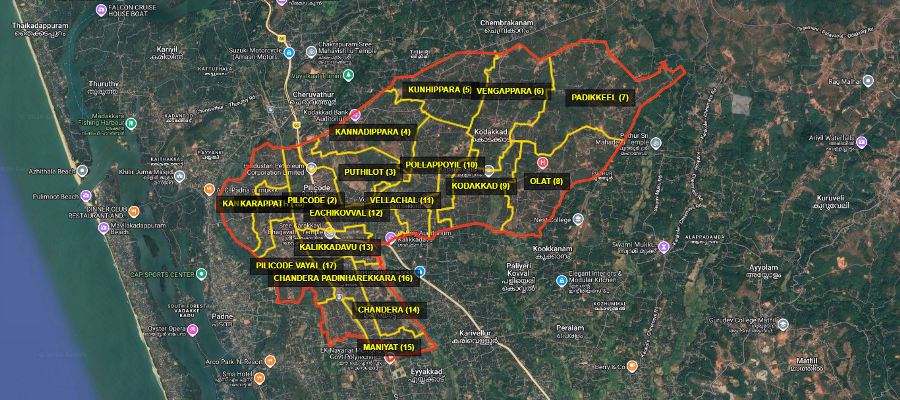
Geography
Geography
Like the general topography of Kerala, this Panchayat is also sloping from east to west. The eastern regions of the Panchayat exhibit the characteristics of midland areas, while the western regions reflect the nature of coastal terrain.
The Grama Panchayat is enriched with inland laterite hills such as Edacheri Hill, Devar Kunnu, Othu Kunnu, Veedu Kunnu, Kallanam Kunnu, Kariyakkara Kunnu, and Mattalayi Kunnu. The highest point in the Panchayat is Bommam Kunnu, situated at an elevation of 104 meters above sea level. About 75.96% of the total land area consists of laterite rock formations. Areas such as Pilicode Kannankai, Mattalayi, Olattu, Valiyapoyil, Vengappara, and Pollappoyil are characterized by compact or layered laterite rock terrain.
The Panchayat contains diverse landscapes including laterite rock regions, coastal lands, wetlands, and grasslands. The soil in the Karappath region of Pilicode contains traces of lignite. Sandy soil is commonly found in the western parts of Pilicode, while clay soil is also available in certain areas.
Five streams originate from the inland laterite hills of the Panchayat, together extending nearly 25 kilometers in length. In earlier times, these streams carried water throughout the year. Pilicode is an ecologically and biologically significant region. Sacred groves protected in the name of faith represent important biodiversity zones. Areas such as Karakkakavu, Cheermakkavu, Eechikulangara Sree Narayanapuram Temple, Shoolappu Kavu, Manjathoor Kavu, Mappidacheri Kavu, Thondachan Kavu (Panayakkattu), and several serpent groves still preserve remnants of rich biodiversity.
The forest area near Kalikkadavu known as Kadvakkad is believed to have once been a “forest of tigers.” Some also believe that the name “Pilicode” originated from “Pulikkadu,” meaning tiger forest. The influence of biodiversity is evident in the customs, rituals, and agricultural traditions of the region. During temple festivals and seasonal celebrations, flowers such as Murikkin Poo, Athirani Poo, and Kattappoo—symbols of the region’s natural richness—were traditionally used.
Before the harvest season, households celebrated “Nira,” a traditional ritual. Decorative arrangements called “Nirakola” were made using leaves from trees and plants such as Athi, Ithi, Banyan, Peepal, Kanjira, Mango, Poluvalli, Soothravalli, Betel leaves, and bamboo leaves. Floral decorations during Onam also reflected the biodiversity of the region. The disappearance of many of these flowers today indicates ecological degradation.
The sacred groves of the Panchayat still preserve several medicinal and native plant species including Kunthalappala, Nannava, Soothravalli, Orilathamara, Pachilapporul, Adapariyan, Aanachuvadi, Eeshwaramooli, Elithadi, Karimuthil, Kattuthippalli, and Pail. Fruits like Thoovakkaya obtained from the groves were once used as nutritious traditional food. Even today, this tradition survives in Karakkakavu as a reminder of the past.
The traditional practice of consuming eighteen varieties of leafy vegetables during the Malayalam month of Karkidakam was an indigenous way of overcoming seasonal scarcity and maintaining health. Pilicode was once rich in naturally growing edible plants such as Muthil, Chena, Chembu, Koduthuva, Cheera, Muringa, Ponnankanni, Thakara, Mulcheera, Sambarcheera, and Thal. Children often relied on naturally available fruits and forest produce instead of processed snacks. Items such as Mottampuli, coconut sprouts, sprouted cashew kernels, gooseberries, banana blossom honey, and guavas were once abundant in the region.
Biodiversity provided not only food but also toys, medicines, household tools, construction materials, pure air, and clean water—essentially supporting every aspect of life in the region.
About sixty years ago, nearly 90% of the houses in the Panchayat were thatched. Walls were built using mud blocks, while roofing materials such as grass, palm leaves, areca wood, and bamboo were locally available. Over time, large-scale quarrying of laterite stones for construction and boundary walls became common. The increasing size of houses and greater use of furniture accelerated the depletion of trees. The spread of nuclear families also contributed to the reclamation of paddy fields and wetlands, leading to complex environmental challenges.
There is no doubt that the biodiversity of the region is closely linked to its geographical location, soil composition, and landforms. Pilicode lies in the tropical zone between 12°17′ North latitude and 75°10′ East longitude. Being influenced by the southwest monsoon, the region receives regular rainfall. Though the northeast monsoon is comparatively weaker, it contributes significantly to groundwater recharge due to slow seepage. This hydrological pattern transformed the inland laterite hills into the origin points of perennial streams.
These year-round water sources supported the agricultural prosperity, biodiversity, and traditional lifestyle of the region. The ongoing impacts of climate change must therefore be understood and evaluated within this ecological context.